How to Build a Business While Working a Job
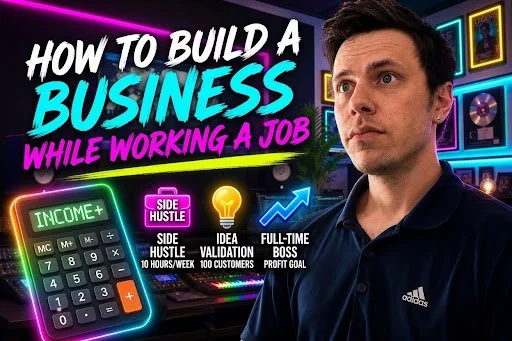
You don’t have to quit your job to start building something of your own.
In fact, keeping your job while you build your business can be one of the smartest ways to become an entrepreneur.
Your paycheck can provide stability.
Your nights and weekends can provide the time.
And your skills, interests, and creativity can become the foundation of something much bigger.
Whether you’re a music producer, recording artist, sports card collector, trading card content creator, breaker, or aspiring entrepreneur, you can start building a business before you’re ready to leave your job.
Your Job Doesn’t Have to Be the Enemy
It’s easy to think:
“I’ll start my business once I can quit my job.”
Flip that mindset.
Instead think:
“I’ll build my business until I no longer need my job.”
Your job can give you something incredibly valuable:
Capital.
Instead of immediately depending on your new business to pay your rent, you can use your existing income to fund:
Equipment
Website hosting
Marketing
Software
Inventory
Advertising
Music production
Content creation
Business education
Your first products
You can build without putting your entire financial life at risk.
Start With What You Already Know
You don’t necessarily need to invent a completely new business.
Look at what you’re already doing.
Are you a music producer?
You could build a business around:
Beat licensing
Production services
Sample packs
Sound kits
Music publishing
Mixing
Courses
Content
Sponsorships
Are you an artist?
You could build around:
Music
Merchandise
Digital products
Performances
Fan memberships
Sponsorships
Content
Licensing
Are you a sports card collector?
Your hobby could become:
Card content
Box breaks
Affiliate marketing
Card sales
Sponsorships
YouTube content
Social media
Collecting education
A community
Are you a trading card content creator?
Your content can eventually become a business through:
Advertising
Sponsorships
Affiliate revenue
Products
Memberships
Brand partnerships
E-commerce
Events
The important question isn’t:
“What business should I start?”
It’s:
“What skills, interests, knowledge, or audience do I already have that could become a business?”
You Don’t Need 40 Hours a Week
One of the biggest advantages of starting while employed is that you can focus on consistency instead of desperation.
You might only have:
1 hour before work.
2 hours after work.
A few hours on Saturday.
That’s enough to start.
Imagine spending 10 focused hours every week building your business.
That’s roughly:
520 hours per year.
Five hundred twenty hours can create an incredible amount of progress.
You don’t need to build everything at once.
You need to keep building.
Create a Schedule
Your business needs dedicated time.
Don’t simply tell yourself you’ll work on it “when you have time.”
Create a schedule.
For example:
Monday: Content creation
Tuesday: Product/business development
Wednesday: Social media
Thursday: Website/SEO
Friday: Rest
Saturday: Deep work
Sunday: Planning
Your schedule doesn’t have to look like this.
The point is to create repeatable business building time.
Focus on High Leverage Work
You don’t have unlimited time when you’re working a job.
So don’t spend all of your free time doing things that don’t move the business forward.
Ask yourself:
“What activity could create the biggest result for my business?”
For a producer, that might mean creating a catalog of great beats.
For an artist, it might mean consistently releasing content.
For a card creator, it might mean producing searchable videos.
For an entrepreneur, it might mean building an email list or website.
Work on the things that compound.
Build an Audience While You Build the Business
One of the most valuable things you can build before quitting your job isn’t revenue.
It’s attention.
Start creating content around what you’re building.
Document your journey.
Teach what you’re learning.
Share your wins.
Share your failures.
Show behind the scenes content.
Give people a reason to follow you.
Over time, your audience can become the foundation for your business.
Don’t Wait for Perfect
Your first website probably won’t be perfect.
Your first product probably won’t be perfect.
Your first video probably won’t be perfect.
Your first song probably won’t be perfect.
Your first business idea might even fail.
That’s okay.
Your goal isn’t to create a perfect business on day one.
Your goal is to learn what works.
Every customer teaches you something.
Every post teaches you something.
Every failed idea teaches you something.
Every sale gives you information.
You’re not just building a business.
You’re building entrepreneurial experience.
Reinvest Your Early Profits
When your business starts making money, it can be tempting to immediately spend it.
Instead, consider putting some of your early profits back into growth.
For example:
$100 revenue → reinvest $50
$500 revenue → reinvest $250
$1,000 revenue → reinvest $500
You can use profits to improve your website, create better content, purchase inventory, acquire software, run advertising, or develop new products.
The goal is to turn a small side business into something capable of producing increasingly larger results.
Know When It’s Time to Leave Your Job
Quitting your job shouldn’t be based solely on excitement.
It should be based on evidence.
You may eventually want to consider leaving when your business has:
Consistent revenue
Multiple income sources
A growing audience
Repeat customers
Emergency savings
Predictable expenses
A clear growth strategy
The goal isn’t to escape your job as quickly as possible.
The goal is to build enough leverage that leaving becomes a reasonable business decision.
Your Side Hustle Can Become Your Main Business
A music producer working after hours can eventually build a production company.
An artist can eventually turn their audience into a sustainable career.
A card collector can turn a hobby into a media and e-commerce business.
A content creator can turn an audience into products, sponsorships, and other revenue streams.
You don’t know where your side project can lead.
That’s why starting matters.
You Don’t Need Permission to Start
You don’t need to call yourself an entrepreneur.
You don’t need an office.
You don’t need employees.
You don’t need investors.
You don’t need to quit your job.
You need an idea, some available time, and the willingness to consistently execute.
Start small.
Build something.
Learn.
Improve.
Make your first dollar.
Then your first $100.
Then your first $1,000.
Keep going.
Your Job Can Fund Your Freedom
Your job provides income today.
Your business can potentially create freedom tomorrow.
Instead of viewing your job as the thing keeping you from becoming an entrepreneur, use it as the financial foundation that allows you to experiment, learn, and build without having to bet everything at once.
Whether you’re making beats, releasing music, collecting sports cards, opening trading card boxes, or creating content around your favorite hobby, you can start building the business before you quit the job.
The best time to start isn’t when you have unlimited time.
It’s when you decide to use the time you already have.